
The Innovation Capacity Framework
Why growth stalls, and how to build the capacity to execute what matters most.
Your church does not need more ideas. It needs the capacity to execute what matters most, consistently over time.
The Innovation Capacity Framework helps church leaders identify the real constraints that stall growth, dilute focus, and keep good ideas from taking root.
Why churches feel stuck
You can feel it. What worked before is not producing the same results.
Reaching your community is getting harder. Attendance is less consistent. Evangelism has stalled. New ideas keep surfacing, but lasting progress remains difficult.
The problem is not creativity. It is not vision. It is not effort.
The problem is capacity.
You don't need more ideas, because you can't execute the ideas you have. And until that changes, new strategies will only increase the pressure on a system that is already stretched thin.
The issue is not innovation. It's execution.
Innovation is often treated like an event. A new initiative. A new strategy. A new ministry idea.
But lasting growth does not come from isolated moments of change. It comes from your church’s ability to carry change all the way through.
That is what innovation capacity means: the ability to consistently execute what matters most over time.
And it is not built by adding more.
It is built by removing what stands in the way.
Innovation capacity is built
by what you eliminate.
Capacity grows through disciplined subtraction
Every new idea added to an already full system increases pressure.
Capacity increases when you eliminate what competes with what matters most.
That means innovation capacity is not built through addition. It is built through disciplined subtraction:
- fewer competing priorities
- less ambiguity
- less reinvention
- less overload
- less dependency on one leader
This is why the framework works. It focuses on removing constraints, not piling on more activity.
The 5 Pillars of Innovation Capacity
The five constraints that determine your capacity to execute
Each pillar represents a constraint. Capacity increases as each constraint is removed.
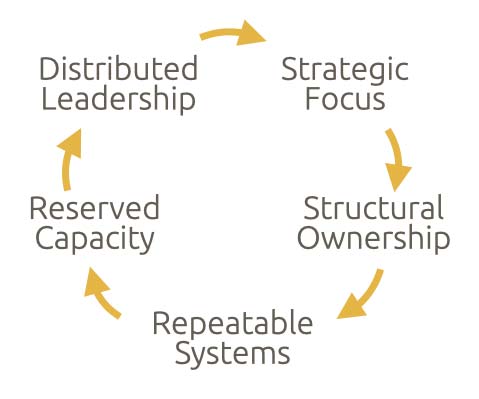
1. Strategic Focus
Eliminate competing priorities.
2. Structural Ownership
Eliminate ambiguity.
3. Repeatable Systems
Eliminate reinvention
4. Reserved Capacity
Eliminate overload
5. Distributed Leadership
Eliminate dependency
This whole framework is a subtraction model, not a build model.
How It Works as a System
Your weakest constraint limits the whole
These five pillars are not independent tactics. They work together as a system of constraints.
- You can have clear priorities, but if ownership is unclear, nothing moves forward.
- You can assign ownership, but without systems, execution becomes inconsistent.
- You can build systems, but without margin, they break under pressure.
- You can create margin, but if everything still depends on you, progress gets bottlenecked.
- You can develop leaders, but if priorities are not clear, their efforts will be scattered.
Your capacity is not determined by your strongest area. It is limited by your weakest constraint.
What this changes
This framework changes how you lead.
Your role is not only to cast vision. Your role is to build the capacity of your church to execute that vision.
That means making hard decisions about what not to do. It means clarifying priorities, assigning ownership, building systems, protecting margin, and developing leaders who can carry responsibility.
Without innovation capacity, even the right vision will stall.
With it, your church can adapt, execute, and grow in a changing world.
Your First Step
Define one primary goal for this season.
Then identify the three strategic priorities required to achieve it.
Everything else is secondary, or it stops.
If your team is working toward multiple primary goals, you are not increasing capacity. You are dividing it.
This is where innovation capacity begins.
Not with more ideas, but with the discipline to ruthlessly eliminate what does not matter most.
Request the White Paper
Get the full white paper and explore the complete Innovation Capacity Framework in more depth, including the five pillars, the system behind them, and the role of disciplined subtraction in sustainable church growth.
If you want a clearer way to diagnose what is holding your church back and a practical framework for moving forward, request the white paper today.